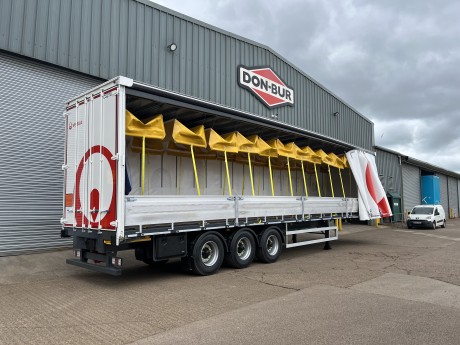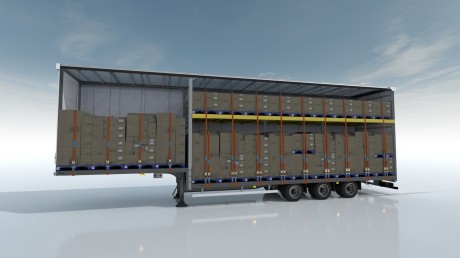
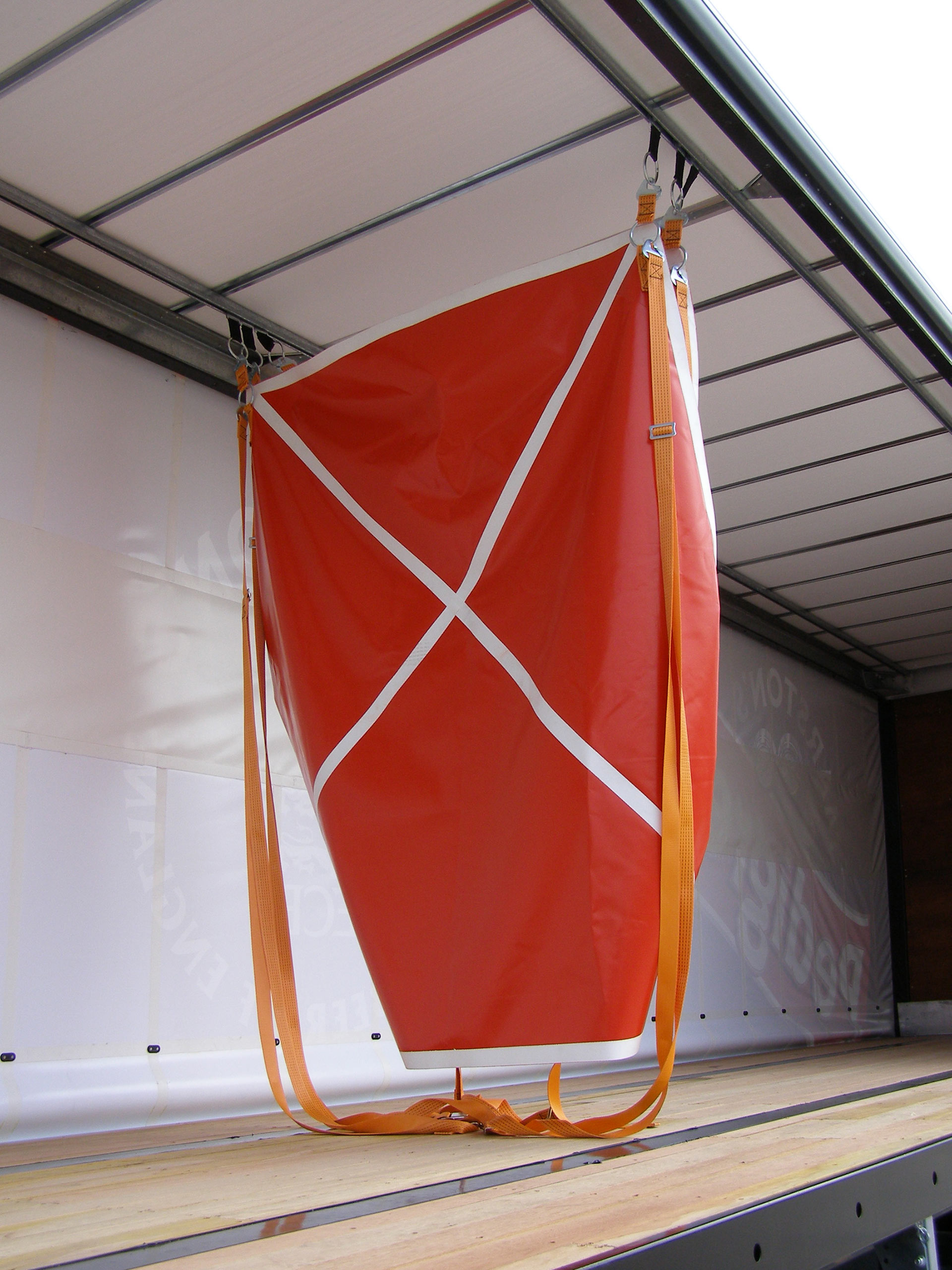
A "nappy" or "kite" load restraint system is a transverse net or sheet installed inside a trailer or rigid vehicle, tensioned across the width to prevent forward or rearward load movement during braking and transit.
These systems are typically suspended from roof-mounted tracks and secured to the side raves using over-centre cam buckles or ratchets. Once tensioned, they act as a barrier behind the load, helping to control movement without securing individual items.
The restraint can be manufactured from open mesh netting or solid PVC canvas, depending on the level of containment required. Reinforced webbing is often incorporated to improve durability and extend service life.
How do nappy and kite load restraint systems work?
The net or sheet is positioned behind the load and tensioned across the width of the vehicle using ratchet straps or over-centre cam buckles fixed to the side raves. Once tensioned, it forms a transverse barrier that resists forward or rearward load movement during braking or acceleration.
By transferring load forces into the vehicle structure rather than the load itself, the system helps reduce the risk of load shift, particularly in mixed or loosely stacked consignments.
Most systems are suspended from roof-mounted tracks, allowing them to be repositioned as required. This is particularly useful for multi-drop operations where the load position changes throughout the journey.
What is the difference between a nappy and a kite system?
The terms "nappy" and "kite" are commonly used interchangeably to describe transverse net restraint systems. Any differences typically relate to the shape or configuration of the sheet rather than its function.
In practice, both systems perform the same role: restraining loads from moving front-to-back within the vehicle. Selection is usually based on operator preference or specific application requirements rather than a defined technical distinction.
Where are these systems typically used?
Nappy and kite systems are commonly used in curtainsiders and box vans where loads are not fully restrained by other methods. They are particularly suited to palletised goods, roll cages, or mixed consignments where a simple transverse barrier provides effective control.
They are also widely used in operations where speed and simplicity are important, as the system can be deployed quickly without securing individual items.
Frequently Asked Questions
What is a nappy or kite load restraint system?
A nappy or kite system is a transverse net or sheet tensioned across a vehicle behind the load, creating a barrier that helps prevent forward or rearward movement during braking, acceleration, or normal transit.
How are nappy and kite systems secured?
They are typically suspended from roof-mounted tracks and tensioned to the side raves using over-centre cam buckles or ratchets, allowing quick deployment and adjustment as load positions change.
What materials are used in these systems?
They can be made from open mesh netting or solid PVC canvas, often reinforced with webbing to improve strength, durability, and resistance to wear in regular operational use.
Can these systems be repositioned during deliveries?
Yes, most systems run on roof-mounted tracks, allowing them to slide along the vehicle so they can be repositioned easily as loads are added, removed, or redistributed during multi-drop operations.