
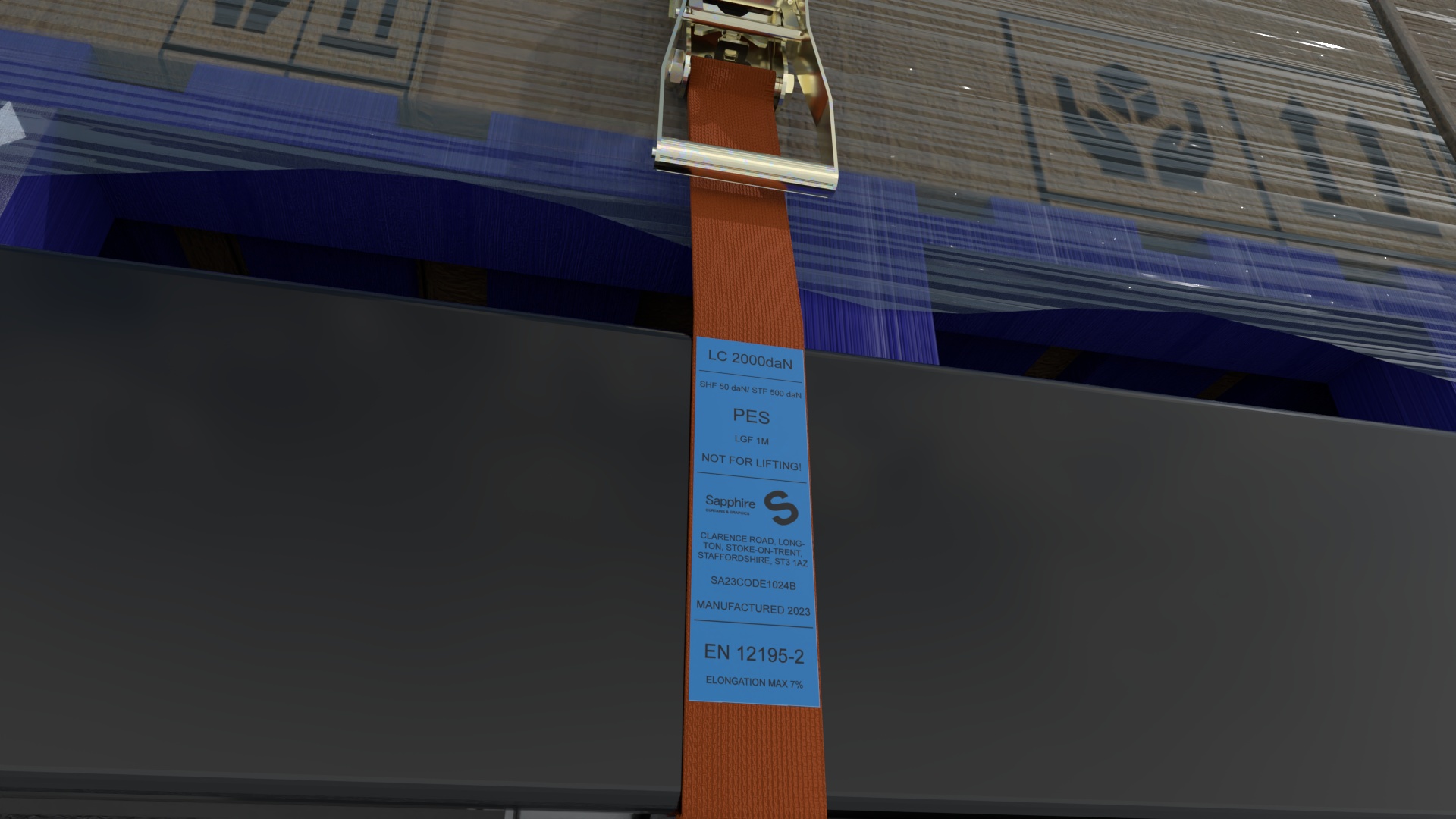
EN 12195 is the European standard that ensures loads on commercial vehicles are securely restrained using properly rated lashing straps and other restraint systems. This standard provides guidelines on both the calculations for load restraint (Part 1) and the specifications for the lashing straps themselves (Part 2).
Part 1: Key Factors in Securing Loads
Part 1 of EN 12195 focuses on the calculations needed to determine how many straps and how strong they need to be to safely secure a load. The key factors that must be considered are:
- Load Weight – The total weight of the load to be secured.
- Coefficient of Friction (CoF) – The friction between the load and the surface of the vehicle. A high coefficient means the load is less likely to slide.
- Angle of the Strap – The angle at which the strap is applied to the load. Different angles provide varying levels of effectiveness in securing the load.
- Strength of the Strap – The lashing capacity (LC) of the strap, which represents the maximum force it can handle in use.
The purpose of these calculations is to make sure that the load is adequately secured during transit, preventing it from shifting, which could lead to accidents or damage.
Part 2: Required Information on a Lashing Strap Label
Part 2 of EN 12195 defines the strength and testing standards for lashing straps and outlines the specific markings that must appear on the label. These markings provide essential information for safe use and compliance.
Here is the complete list of mandatory information that must be present on the label of a lashing strap:
-
LC (Lashing Capacity) – The maximum force the strap can withstand when in use, expressed in decanewtons (daN). For example, an LC of 2000 daN means the strap can safely handle a straight pull force of up to 2000 daN.
-
LGF (Length of Fixed End) and LGL (Length of Adjustable End) – The label must indicate the length of both the fixed and adjustable parts of the strap. The LGF refers to the fixed length, while the LGL represents the adjustable part that can be tightened or loosened.
-
SHF (Standard Hand Force) – This represents the amount of hand-applied force required to tighten the strap using a tensioning device (such as a ratchet). SHF is standardised at 50 daN.
-
STF (Standard Tension Force) – The residual tension left in the strap after it has been tightened by a ratchet or winch mechanism. For example, an STF of 500 daN means the strap maintains 500 daN of tension after being fully tightened.
- Warning: "Not for Lifting" – This mandatory warning informs the user that the strap is not designed for lifting objects, only for securing loads.
- Material of the Textile Webbing – The label must indicate the material used in the strap, typically polyester (PES), polyamide (PA), or polypropylene (PP). These materials have different properties affecting their resistance to elements like UV light, chemicals, and moisture.
- Manufacturer’s or Supplier’s Name or Symbol – The label must include the name, logo, or symbol of the manufacturer or supplier, ensuring traceability.
-
Manufacturer’s Traceability Code – A unique code that allows the lashing strap to be traced back to its production batch, useful for safety checks and quality control.
-
EN 12195-2 Standard Reference – The label must include the reference to the applicable standard, in this case, EN 12195-2, indicating compliance with European regulations.
-
Year of Manufacture – The label must display the year in which the strap was produced, as the effectiveness of the strap can degrade over time due to wear and exposure.
-
Elongation at LC – The label must state the maximum elongation (stretch) of the webbing when subjected to the Lashing Capacity (LC). This is typically expressed as a percentage, e.g. "Elongation max 7%" means the webbing will not stretch more than 7% of its length when loaded to its maximum LC.
Understanding Additional Acronyms
In addition to the mandatory label information, you may encounter these terms:
- BF (Breaking Force) – Although not required on the label, the Breaking Force (BF) represents the maximum force the strap can handle before it breaks. BF is typically double the LC, providing a safety margin. For instance, a strap with an LC of 2000 daN may have a BF of around 4000 daN.
Understanding the Relationship Between LC, SHF, and STF
To grasp how lashing capacity (LC), standard hand force (SHF), and standard tension force (STF) relate to one another, it’s important to consider both their individual purposes and how they work together when securing a load.
-
Lashing Capacity (LC): The LC is essentially the strap’s maximum working load limit. It’s the amount of force the strap can safely handle when in use to restrain a load. For example, if a strap has an LC of 2000 daN, this means it can securely hold a load up to that force. Anything beyond this risks overloading the strap and potentially causing failure. The LC is derived from half of the breaking force (BF), offering a significant safety margin in practice.
-
Standard Hand Force (SHF): SHF is a fixed standard of 50 daN, regardless of the strap’s size or strength. It represents the amount of force a person can apply by hand when using a tensioning device (like a ratchet). This is important because it's the baseline effort that should be applied by an operator to tighten the strap. Since this value doesn’t vary from one strap to another, it ensures consistent application and prevents over-tightening, which could weaken the strap over time.
-
Standard Tension Force (STF): This is where things get more specific to each strap and its design. STF refers to the residual tension left in the strap after tightening. For example, even if you apply the standard 50 daN hand force (SHF), the tension remaining in the strap may be around 500 daN (STF). This is because the ratchet mechanism multiplies the force applied by hand, creating greater tension than the operator initially applies.
However, the STF is often lower than the LC, and that’s crucial for understanding the strap’s true effectiveness. Even though the tension left in the strap is lower (say 500 daN STF compared to 2000 daN LC), this doesn’t mean the strap is “weaker.” The LC represents the strap’s total holding strength when the load shifts or needs to be secured. The STF, on the other hand, measures the tension actively holding the load in place after tightening. Essentially, while the STF maintains the grip on the load, the LC provides the buffer that ensures the strap can handle dynamic forces during transit.
How They Work Together
Think of the LC as the safety margin—the full force the strap can withstand without breaking—while the STF is the force keeping the load steady and secured at any given moment. The SHF is simply the amount of force needed by an operator to set the STF into motion, making sure the strap is properly tensioned.
In a practical example:
- You might use a ratchet to apply 50 daN of hand force (SHF).
- This results in 500 daN of tension remaining in the strap (STF), enough to keep the load secure under normal conditions.
- However, if the vehicle stops suddenly or swerves, the LC (say 2000 daN) ensures the strap can handle the increased forces exerted by the shifting load without snapping.
Thus, the relationship between LC, SHF, and STF highlights different layers of safety and functionality: the LC protects against overloading and emergencies, while the STF ensures that under normal transit conditions, the load is secure.
We’d love to hear from you – get in touch today!