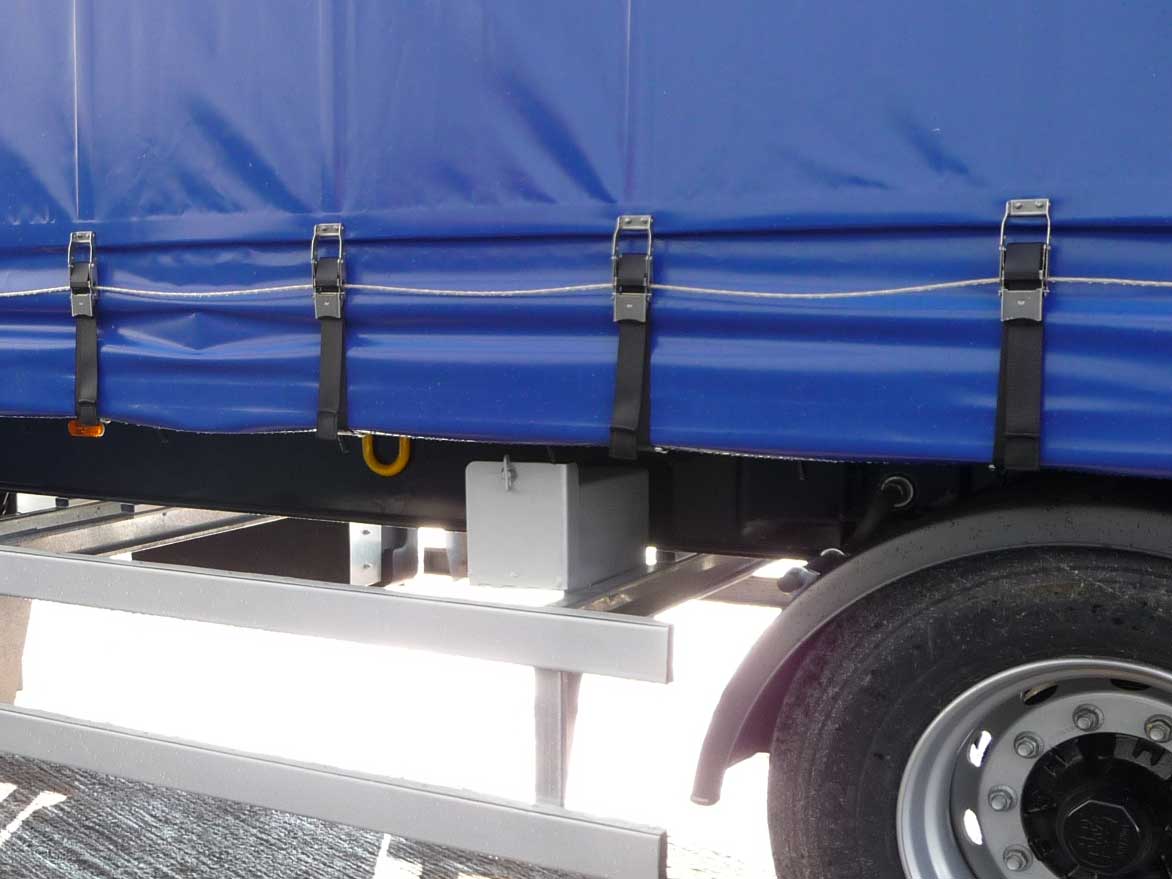
TIR (Transports Internationaux Routiers) is an international customs transit system that allows sealed HGVs and trailers to cross multiple borders under a single TIR Carnet with minimal checks. For a trailer to operate under the TIR system, the load space must be customs-sealable and the vehicle must hold a valid Approval for the Transport of Goods under Customs Seal (“TIR approval”). This page summarises the build standards, type-approval options, UK approval process, marking requirements and maintenance obligations for operators involved in cross-border movements.
What does “TIR-approved” mean?
A TIR-approved vehicle or trailer has been certified so that goods cannot be removed or introduced into the load compartment without leaving visible traces of tampering, and the space can be effectively sealed by customs. These requirements derive from the UNECE TIR Convention (1975) — Annex 2 sets the construction and approval rules for road vehicles, Annex 6 provides explanatory notes (including seal specifications) and Annex 7 covers containers and demountables.
Individual vs type (series) approval
Under TIR Convention Annex 2, Articles 4 & 5, vehicles may be approved either individually or by type (also known as series approval). A type approval covers a model or family of trailers built to an identical, pre-approved design. Once that design has been accepted, individual trailers built to the same specification can receive a GV60 Certificate of Approval without further inspection. This is equivalent in principle to an EN 12642-XL or vehicle type-approval model system.
In the UK, type or “model” approvals are managed through DVSA model reports. These allow a manufacturer to demonstrate that a specific design complies with the TIR sealing requirements so that future builds of the same design can be approved efficiently. Applications for model reports or TIR tests at non-DVSA facilities are made using the VTG10 form.
Where only one trailer or body is built, or if significant design changes affect sealing integrity, an individual approval inspection must be carried out before a GV60 can be issued.
Trailer construction requirements (summary)
- Enclosed load space: The body must fully enclose the cargo (box/van, tilt/curtainsider or demountable/container type).
- Customs-sealable closures: Doors, flaps and access points must accept approved customs seals. When closed, hinges and bolts must not be removable or accessible from outside.
- No hidden access: Walls, roof and floor must be permanently fixed so that entry is impossible without visible damage. Internal fixings or protected fasteners must be used where appropriate.
- Limited openings: Openings, including roof sections, must be arranged so a minimum number of seals provides complete security and any attempt at entry leaves visible traces.
- Sealing points: Eyes, hasps and securing features must be sized and positioned according to the Convention diagrams. Wear must not enlarge the holes or reduce the seal’s effectiveness.
Notes specific to tilt and curtainsider bodies
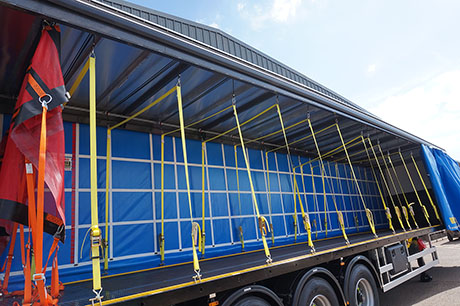
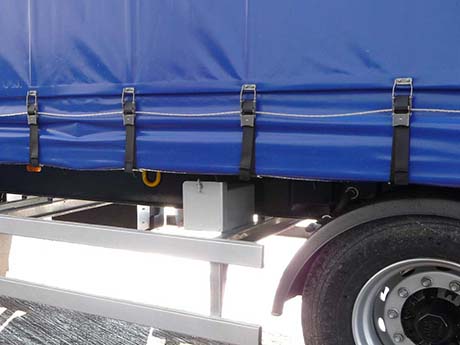
- Continuous steel cable: A flexible steel wire runs through the curtain’s reinforced upper and lower edges, terminating in certified end rings (front and rear) connected to approved seal points.
- Reinforced curtain edges: Edges must prevent prying access and close tightly against stanchions and corner posts when sealed.
- Side-rave interfaces: The design must ensure the sealed curtain cannot be displaced to access the load space.
Approval process (UK & international)
- Design & build: The trailer must be manufactured to meet the construction requirements of TIR Convention Annex 2 for load spaces carried under customs seal.
- Competent authority & inspection: In the UK, HM Revenue & Customs (HMRC) is the competent authority responsible for TIR approvals. Inspections are carried out by the Driver and Vehicle Standards Agency (DVSA), which conducts the TIR test to verify compliance of the sealed compartment. Source: GOV.UK – TIR test
- Certificate of approval: Once passed, a GV60 Certificate of Approval (for the transport of goods under customs seal) is issued. The certificate must be carried with the vehicle at all times during TIR movements and is normally valid for two years.
- Approval plate: A plate marked “APPROVED FOR THE TRANSPORT OF GOODS UNDER CUSTOMS SEAL” may also be fitted in a visible position, but the GV60 certificate remains the controlling document.
- Operator readiness: The haulier must be admitted by a recognised national guaranteeing association — in the UK this is either the Road Haulage Association (RHA) or Logistics UK (formerly FTA) — and must use valid TIR Carnets for any TIR movements.
Note: TIR movements originating in Great Britain are not entered into the NCTS (New Computerised Transit System) at departure. A declaration to NCTS is made only when the goods first enter the EU customs territory.
Markings & in-use requirements
- TIR plates: During TIR movements, vehicles must display rectangular blue signs with white “TIR” lettering front and rear, conforming to the dimensions in Annex 5 of the TIR Convention. On semi-trailers, the front plate must be positioned where it remains visible when coupled.
- Seals: Only customs-approved sealing devices may be used. The seals applied at the office of departure must remain intact to destination and correspond to the seal numbers shown in the TIR Carnet (and any NCTS record).
- Identification: Vehicle registration and chassis details must match those on the approval certificate. The original GV60 certificate must be kept on board — photocopies are not accepted by customs.
When do I need TIR approval?
TIR applies to international road-haulage journeys between TIR Contracting Parties (for example UK–EU–Turkey). It simplifies cross-border procedures but is separate from domestic roadworthiness or type-approval requirements. For purely domestic routes or where all countries involved are outside the TIR chain, standard transit regimes (such as Union Transit or Common Transit) may apply instead.
Specifying a TIR-compliant curtainsider (checklist)
- Reinforced curtain edges with a continuous steel wire and compliant end rings.
- Certified seal points / eyes at rear doors and front bulkhead (where applicable) per Annex 2 sketches.
- Protected hinges / bolts that cannot be removed from outside when closed.
- Roof systems: Opening or sliding roofs must be capable of being sealed with minimal seals and must reveal tampering clearly.
- Approval plate location: Reserve a position for the approval plate and retain the GV60 certificate in the vehicle file.
Maintenance & re-approval
The GV60 certificate is valid for two years. Any structural repairs, panel replacements, curtain changes or hardware modifications that could affect sealing integrity invalidate the approval until the vehicle or trailer has been re-inspected and recertified. Keep records of repairs and arrange a DVSA TIR test or HMRC-authorised inspection before the next TIR movement. Lost or damaged certificates must be reported immediately; replacement approvals are issued only in specific circumstances.
Containers & demountable bodies
Container and demountable approvals under TIR Convention Annex 7 are carried out by HMRC-authorised certification bodies such as Bureau Veritas, Lloyd’s Register, HSB or DEKRA. Each approved unit must display a permanent plate showing the authority, approval number and year of issue in the prescribed format.