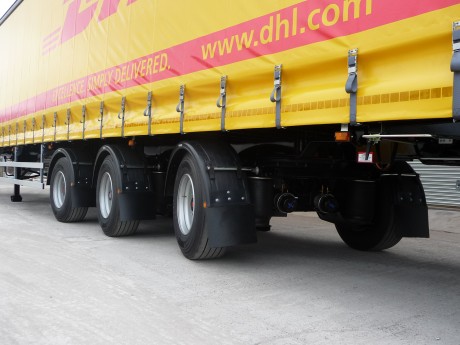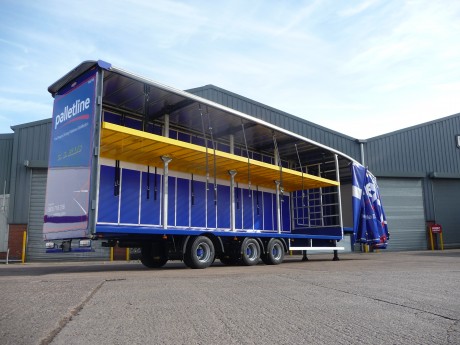

Today, the DfT has finally rubber-stamped the use of Longer Semi Trailers (LSTs) for general use on UK Roads. This follows their press release earlier this month suggesting that legislation would be laid on 10 May to safely roll out the vehicles from 31 May.
Many believed that operators would be able to run LSTs like standard 13.7m long trailers when they became legal and that the existing length regulations would be increased by 2.05m to suit. That's not quite how this is going to be governed.
The existing Road Vehicles (Construction and Use) Regulations 1986 will remain unchanged. LSTs have been added as a new trailer type under the new 2023 No. 524 Road Vehicles (Authorisation of Special Types) (General) Order 2023 (Commonly known as STGO) and yes, caveats are in place for those wanting to operate LSTs under the new statutory regime.
Legal requirements under the newly amended regulation include route plans and risk assessments for each route that an LST is planned to be used. Even diversionary routes are governed so extra care and planning is a must. In addition, the Secretary of State is "legally required to be notified by operators of the prospective use of LSTs – which should be done through the vehicle operator licensing (VOL) system – with operators also required to ensure that drivers are given copies of the route plans and risk assessments for the routes they drive on."
Interestingly, in addition to the minimum legal requirements, there are also a number of guidance measures. "These include driver training and scheduling, record keeping, broader staff training (including transport managers and other staff) and loading of LSTs." Further details can be seen in the new guidance (link at base of page).
Longer Semi Trailers which enter into service from today will be governed automatically by the new regime and conditions can be seen at Conditions of use for new LST operators section, but those operators already using LSTs with VSOs under the existing trial must continue to abide by the trial terms (including those requirements in the operator undertaking). They may however transition their existing LSTs to the new regime at any time in a transition period that starts on 31 May 2023 and lasts until 30 November 2023. After this transition period, any remaining live VSOs will be revoked.
Queries about the impact to you can be forwarded to richard.owens@donbur.co.uk or you can go to our help centre with live chat.
Please also visit our dedicated Longer Semi Trailer page.
What is an LST?
An LST is a Longer Semi Trailer which is described as being longer than 12.0m from kingpin to rear up to a maximum of 14.05m. No part of the trailer can project further forward than a 2.040m front swing radius around the kingpin.
The maximum permitted length of an LST is defined as follows: "The maximum distance measured parallel to the longitudinal axis of any of the semi-trailers from the foremost point of the loading area to the rear of the semi-trailer must not exceed 15.65 metres."
This additional trailer length allows for an increase of up to four UK pallets (1200x1000mm) on a single deck trailer or up to eight UK pallets on an LST with a double deck. The maximum current UK pallet count on an LST is 60.
The maximum combination length is 18.550m and this cannot change for any reason.
Weight however, remains stubbornly limited to 44 tonnes GVW on six axles. Considering the LST unladen weight is generally higher than a standard trailer, operators must keep their wits about them when planning what they can realistically fit into an LST without risking a PG9 for travelling over the plated weight.
They must have 3 axles; one of which must be steered and, where the Gross Vehicle Weight exceeds 38,000kgs, an on-board weighing device must be present. Fortunately, most trailers already have a weighing device on the bogie as part of the braking system so all that's needed is a visual interface in order to read that data. It is not currently possible to determine gross trailer weight without the use of a weigh bridge.
The full official guidance, which supports the new STGO Amendment can be found below in related content links.
We’d love to hear from you – get in touch today!