Modern UK and European HGV trailers rely on secure connections for both electrical power and pneumatic (air brake) systems. While these systems perform similar functions across the world, this guide focuses specifically on UK and European coupling standards, their differences, and the recognised safe methods for coupling and uncoupling.
1. Electrical Couplings
UK Electrical Couplings
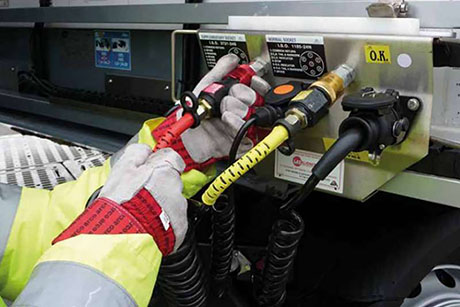
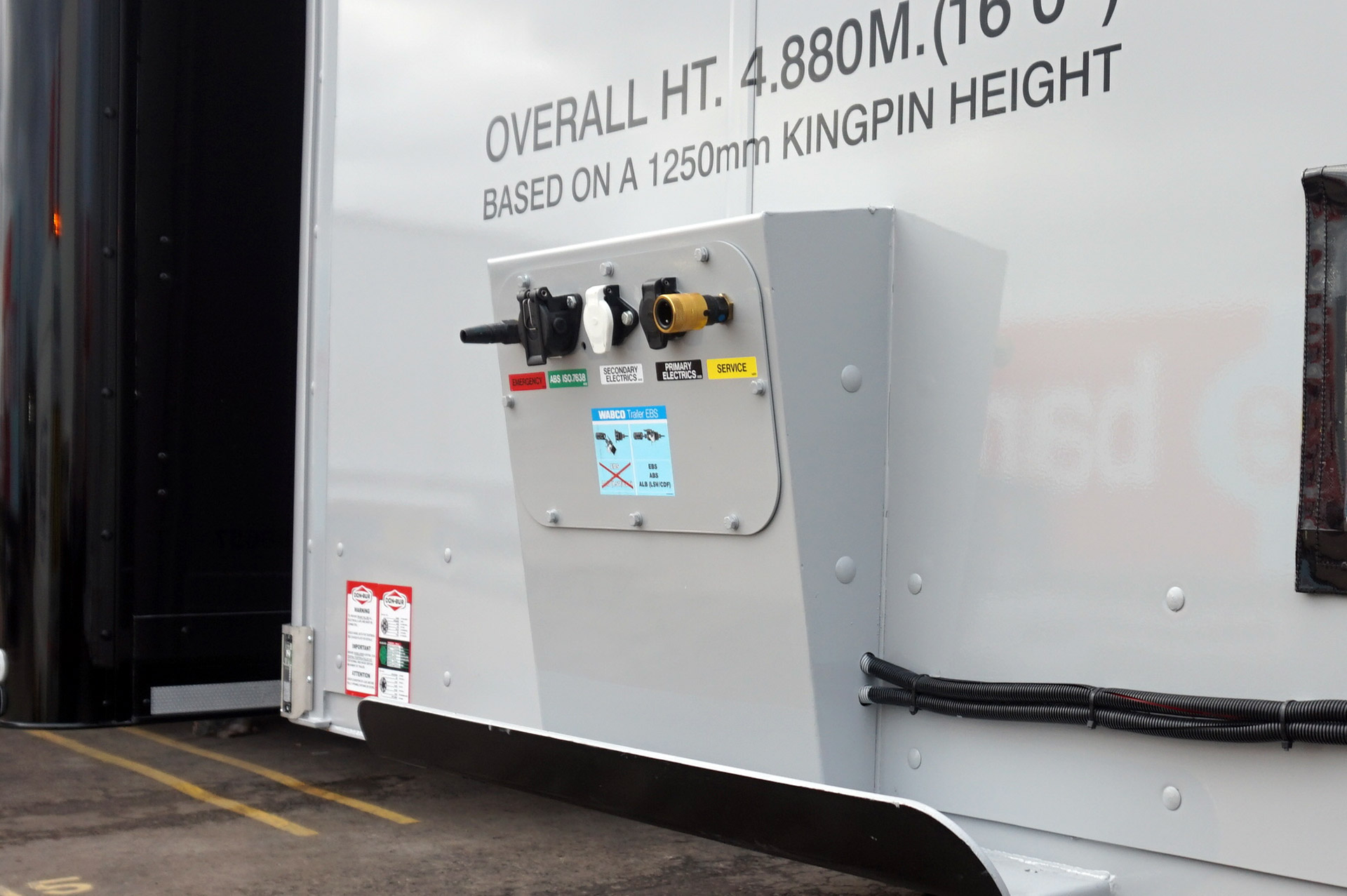
In the UK, most trailers use two separate 7-pin connectors, plus a dedicated line for the trailer ECU controlling the Electronic Braking System (EBS) and ABS:
- 24N (Primary): ISO 1185 – Powers side markers, indicators, brake lights, and tail lights.
- 24S (Secondary): ISO 3731 – Powers reverse lights and rear fog lamps.
- EBS/ABS: ISO 7638 – Dedicated 7-pin connector for the trailer ECU, providing power and CAN data for EBS/ABS and auxiliary systems such as suspension and stability control.
European Electrical Couplings
In many European countries, the separate 24N and 24S connectors are replaced by a single multi-function plug:
- ISO 12098 (15-pin): Combines all road lighting functions and supplementary power into one connector, reducing the number of plug-in points and improving corrosion resistance. Capable of carrying higher current for auxiliary systems.
- ISO 7638: As in the UK, remains the standard EBS/ABS connector, ensuring consistent brake control across Europe.
About ISO 7638 (Why It Matters)
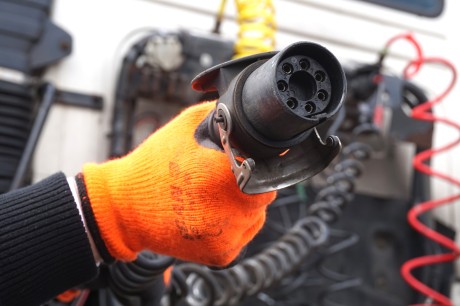
The ISO 7638 connection — often referred to as the EBS line or ABS line — is a dedicated 7-pin “suzie” coupling that supplies both electrical power and data communication to the trailer’s Electronic Braking System (EBS) or Anti-lock Braking System (ABS). It is a legal requirement for all new trailers fitted with ABS or EBS from May 2002 onwards.
This connection powers the trailer’s ECU and enables continuous CAN bus communication between tractor and trailer. Through this link, the tractor transmits brake demand signals, while the trailer provides diagnostics and status. The EBS system also controls advanced safety functions such as:
- Anti-lock braking (ABS)
- Electronic brake force distribution
- Load-sensing brake modulation
- Roll stability control
- Electronic suspension management
- Automatic traction control (where fitted)
If the ISO 7638 connection is not made, damaged, or loses power, the trailer’s ECU is disabled and all of these functions stop working. Braking reverts to basic pneumatic operation with reduced performance, and no electronic safety interventions are available. This compromises safety and may breach legal and operator requirements.
For this reason, the ISO 7638 should be connected first during coupling, inspected regularly for damage, and never used for non-approved auxiliary power tapping. Any warning relating to the EBS line must be investigated before the trailer is put into service.
2. Pneumatic Couplings (Air Lines)
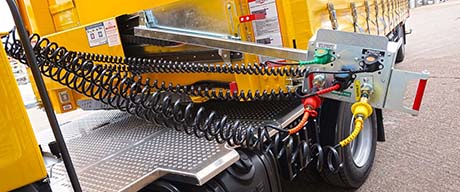
All UK and European HGV trailers use two coiled air lines (“suzies”), colour-coded for clarity:
- Yellow line (Service line): Applies the trailer brakes in response to the tractor’s foot brake.
- Red line (Emergency line): Supplies air to the trailer’s braking system (and, on some trailers, the suspension reservoir) and applies the brakes automatically if disconnected.
Coupling Types – UK vs European
- C-type couplings (UK standard): Collar-style head that snaps securely into place. Widely used across UK tractor/semi-trailer fleets.
- Palm-type couplings (European standard): Flat, disc-shaped connectors that twist-lock together. Each is self-sealing when disconnected to prevent dirt ingress and air loss.
The air system functions are identical; only the coupling hardware differs between regions. Direct connection between C-type and palm-type is not possible without an adapter.
Adapters
Adapters are available to connect UK C-type tractors to EU palm-type trailers, and vice versa. After fitting an adapter, always check for leaks and confirm brake operation before moving the vehicle.
Drawbar / Duomatic (Single-Head) Couplings
Some rigid–drawbar combinations use a Duomatic coupling head that integrates the service and emergency lines into a single plug-in connection. This speeds up coupling and removes the risk of cross-connecting lines, but it creates a single point of failure if the head is damaged or contaminated. Duomatic systems are common on drawbar outfits in parts of Europe and are not typically used on standard UK tractor/semi-trailer combinations.
3. Special Cases: Split Coupling
Split coupling is sometimes used when there isn’t enough space between the tractor and trailer to connect all lines in the standard sequence. This involves connecting some lines before fully reversing under the trailer, with the remainder connected afterwards.
Warning: While sometimes unavoidable in confined areas, split coupling increases risk — particularly if air lines are connected or disconnected while the trailer brakes are released. This can cause unintended trailer movement. Always follow company policy and use the standard coupling procedure wherever possible.
4. Why Correct Coupling Matters
- Safety: Ensures full braking performance and stability control.
- Compliance: Meets HSE/SOE/IRTE Code of Practice and operator requirements.
- Reliability: Prevents electrical faults, air leaks, and suzie damage.
- Efficiency: Reduces downtime and extends component life.
5. Recommended Coupling Procedure
HSE SOE/IRTE procedure for standard UK/European semi-trailers. Deviating from approved practice increases risk.
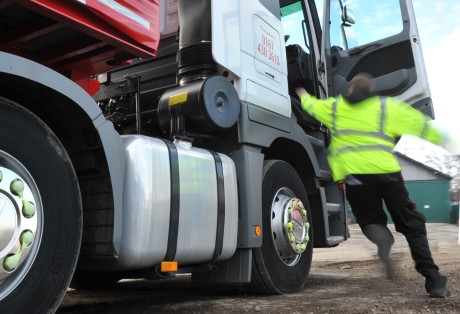
- Reverse slowly in a straight line until the fifth-wheel ramps align with the trailer front.
- Apply the tractor parking brake, stop the engine, and remove the keys.
- Check the trailer parking brake is applied. Do not walk under the trailer.
- Inspect fifth-wheel/locking devices, kingpin and rubbing plate. Do not proceed if damaged.
- Adjust trailer height to align correctly with the fifth-wheel (landing legs or tractor air suspension).
- Reverse until the fifth-wheel jaws engage the kingpin.
- Apply the tractor parking brake, stop the engine, and remove the keys again.
- Visually confirm the kingpin is locked; fit the safety dog clip (or device).
- Select a low gear and, with the trailer brakes still applied, perform a snatch test. Repeat to confirm engagement.
- Connect the service (yellow) airline and electrical connections (ISO 7638 and 24N/24S or ISO 12098).
- Connect the emergency/supply (red) airline and wait a few seconds for any unexpected movement. If the trailer moves, disconnect immediately and re-check both parking brakes.
- Wind up the landing legs and stow the handle. Set air suspension to ride height.
- Fit the number plate and check all lights work.
- Carry out visual and functional checks (load security, height indicator, etc.).
- Release the trailer parking brake. Only set off once all checks are complete.
6. Recommended Uncoupling Procedure
- Park in a straight line. Apply the tractor parking brake, stop the engine, and remove the keys.
- Apply the trailer parking brake.
- Remove and stow the trailer number plate.
- Lower the landing legs until they contact the ground.
- Disconnect all air and electrical connections and stow them (grip airlines firmly as they may kick back under pressure).
- Remove the safety clip and pull the fifth-wheel release handle.
- Slowly draw forward ~300 mm so the fifth-wheel is still under the rubbing plate; apply the tractor parking brake.
- If fitted with air suspension: lower rear air suspension to drop the fifth-wheel away from the trailer, then pull clear and reset to ride height.
- If fitted with mechanical suspension: pull clear and stop when the trailer is clear of the fifth-wheel.
- Before leaving the trailer, walk around and ensure it has been left in a safe condition.
7. UK vs European Coupling Standards
| Type | System | UK Standard | European Standard |
|---|---|---|---|
| Electrical – Lighting & Aux | Side markers, stop, fog, reverse | 24N + 24S (2 × 7-pin) | ISO 12098 (15-pin) |
| Electrical – EBS/ABS | ECU control of EBS/ABS + suspension + stability | ISO 7638 (7-pin) | ISO 7638 (7-pin) |
| Pneumatic – Air Lines | Service & emergency brakes | Yellow/Red with C-type heads | Yellow/Red with Palm heads |
Conclusion
While UK and European trailer coupling systems perform the same core functions, the connector types and configurations differ. Understanding these differences — and following the recognised safe coupling/uncoupling process — ensures compatibility, compliance, and safety for cross-border operations.